
CONDITIONS WE TREAT
Depression Treatment in Sugar Land TX
Depression rarely announces itself the way people expect. For many of the patients we see across First Colony, Telfair, Riverstone, and Greatwood, it shows up as a quiet exhaustion that lingers, a dimming of the things that used to feel good, or a difficulty getting through the workday that does not lift no matter how much sleep you get.
CIP Psychiatry provides depression treatment in Sugar Land under the direction of a board-certified psychiatrist, with in-person visits at our office near Sugar Land Town Square and telehealth available throughout Texas.

Recognizing the Signs
How Depression Shows Up
Depression rarely shows up the way people expect. For patients across First Colony, Telfair, Riverstone, and Greatwood, it often looks like a quiet exhaustion that will not lift, a dulling of the things that used to feel good, or a workday that takes everything you have.
Depression often appears alongside anxiety, ADHD, grief, trauma, or insomnia. Treating one piece in isolation rarely produces lasting relief.
✓ Difficulty concentrating or making decisions that used to feel routine.
✓ Sleeping far more than usual, or lying awake despite exhaustion.
✓ Losing interest in hobbies, exercise, family time, or intimacy.
✓ Irritability and a short temper that feels out of character.
✓ Headaches, body aches, or digestive issues without a clear cause.
✓ Eating noticeably more or less than usual, or unintended weight changes.
✓ Feelings of guilt, worthlessness, or being a burden to others.
✓ In more severe cases, thoughts about death or self-harm.
SUBTYPES
Forms of Depression We Treat in Sugar Land
Depression is not a single diagnosis. Treating it well starts with recognizing which form you are dealing with.
Persistent Depressive Disorder
Chronic, lower-grade depression (formerly called dysthymia) lasting two years or more. Symptoms are milder but unrelenting, and often misread as a personality trait when they actually respond well to treatment.
Premenstrual Dysphoric Disorder
A severe form of PMS with cyclical depressive and irritable symptoms during the luteal phase of the menstrual cycle. Often dismissed as ordinary PMS, but very treatable once it is correctly diagnosed.
Treatment-Resistant Depression
Depression that has not responded to two or more adequate antidepressant trials. Next-step options include transcranial magnetic stimulation, rapid-acting interventional treatments through specialty referral, augmentation strategies, and switching medication classes. Treatment-resistant does not mean untreatable.
Major Depressive Disorder
Persistent low mood, loss of interest, sleep and appetite changes, and impaired functioning lasting two weeks or longer. The most common form of depression we treat at our Sugar Land office..
Seasonal Affective Disorder
Depression that returns in the fall and winter when daylight is limited. Texas patients are not immune. Even mild seasonal patterns can disrupt sleep, energy, and mood enough to warrant treatment.
Psychotic Depression
Severe depression accompanied by hallucinations, delusions, or detachment from reality. Requires combined antidepressant and antipsychotic treatment, or coordinated higher-level care with close clinical monitoring and rapid medication adjustment as needed.
Postpartum and Perinatal Depression
Depression that develops during pregnancy or in the months after childbirth. Treatable with medication, supportive psychotherapy, and coordinated care, including newer treatment options developed specifically for new and expecting mothers.
Situational and Adjustment Depression
Depression triggered by a specific stressor such as job loss, divorce, a medical diagnosis, or a major move. Time-limited but worth treating, especially when it begins to interfere with daily life.
WHY IT HAPPENS
What Causes Depression
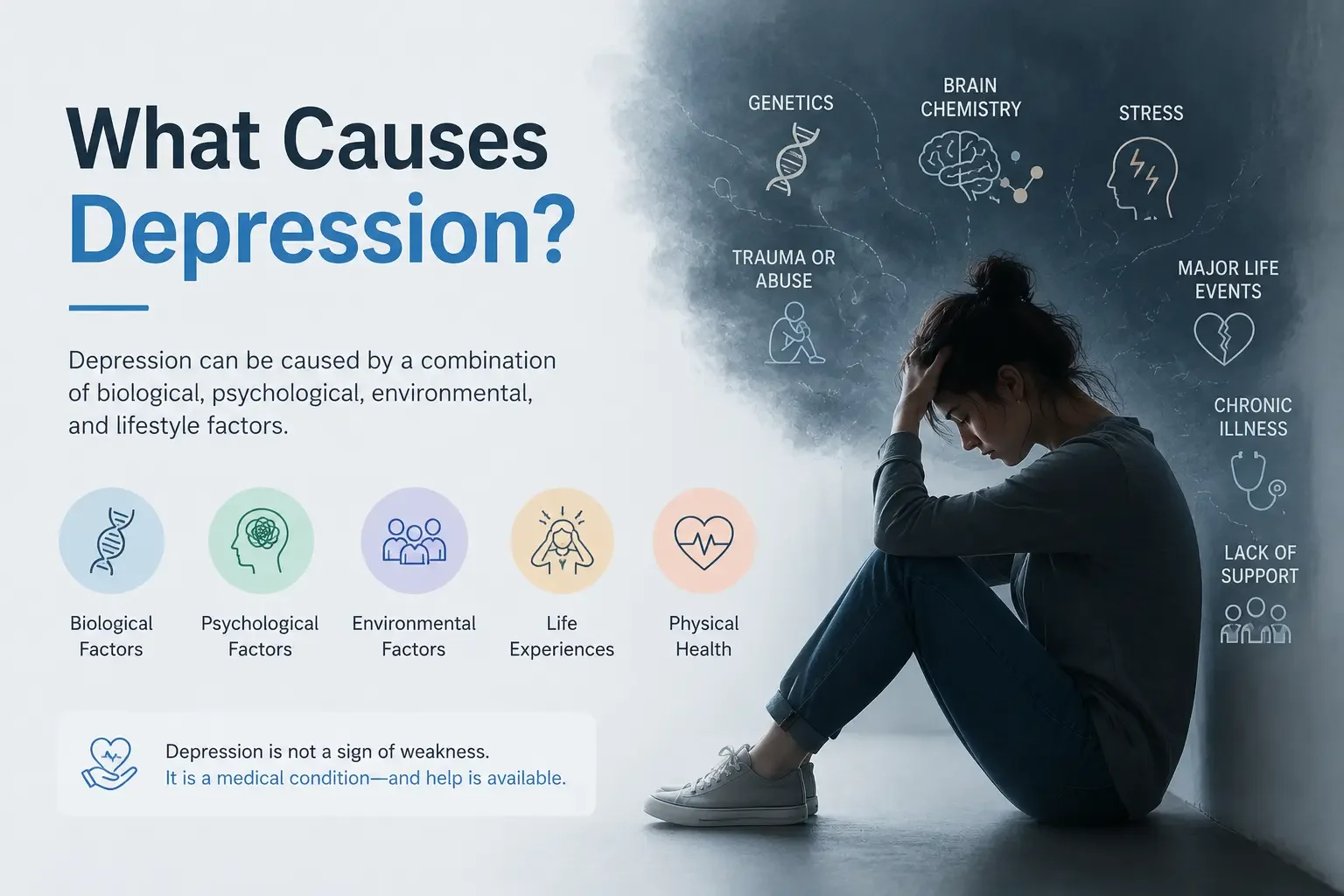
There is no single cause. Depression typically results from a combination of biological factors (genetics, brain chemistry, hormonal changes), psychological patterns (how you process stress, loss, or conflict), and life circumstances (relationship difficulties, financial pressure, career transitions, grief, trauma). Some patients can trace their depression to a specific event. Others describe it as something that has been present in the background for years.
What is not helpful is the idea that depression is a character flaw or something you should be able to will yourself out of. The neuroscience is clear: depression involves measurable changes in brain function, neurotransmitter activity, and stress-response systems. It deserves the same clinical attention as any other medical condition.
How We Treat Depression at CIP Psychiatry
OUR APPROACH
Our approach starts with a 50-minute psychiatric evaluation that goes well beyond a symptom checklist. The treatment plan that follows is built around your situation, not a one-size-fits-all protocol.
-
1
Comprehensive Psychiatric Evaluation
Your first visit is a 50-minute conversation. We want to know your history, what you have already tried, what your day looks like, and what you are hoping to get back. This is the foundation for a plan that fits.
-
2
Medication Management, Used Thoughtfully
When medication is appropriate, we explain the rationale, what to expect, potential side effects, and how long treatment typically lasts. Our philosophy is the minimum effective intervention. When patients are stable and ready, we help them taper off.
-
3
Therapy Built Into Every Visit
Each 25-minute follow-up includes brief supportive psychotherapy alongside medication review, drawing on cognitive behavioral therapy, interpersonal therapy, and behavioral activation. For patients who need more intensive therapy, we connect you with trusted therapists in our referral network.
-
4
Lifestyle and Wellness Support
Sleep, exercise, nutrition, and social connection all affect depression directly. We build these into the plan as a complement to clinical treatment, not a replacement for it.
If standard treatment has not worked
About one in three patients does not respond fully to a first or second antidepressant trial. Next-step interventions include genetic testing, transcranial magnetic stimulation (TMS), augmentation strategies, and coordinated referrals to specialty centers for interventional treatment options when appropriate. Treatment-resistant does not mean untreatable.
MEDICATIONS
How We Approach Antidepressant Medication
A starting point, not a prescription
The right medication depends on your symptoms, history, prior responses, side-effect tolerance, and any other medications you take. Most antidepressants fall into a small number of well-studied categories, each working through a different mechanism. We choose the category and dose that best fits your situation, then adjust as we see how you respond.
SSRIs (Selective Serotonin Reuptake Inhibitors)
The most commonly prescribed first-line option for depression. SSRIs work by increasing the availability of serotonin in the brain. They are generally well tolerated and used for both depression and anxiety. Most patients start to notice changes over four to six weeks.
SNRIs (Serotonin-Norepinephrine Reuptake Inhibitors)
A second-line option that works on both serotonin and norepinephrine. SNRIs are often considered when SSRIs have not produced enough improvement, or when depression occurs alongside chronic pain, fatigue, or significant low energy.
Atypical Antidepressants
A category that does not fit neatly into SSRI or SNRI mechanisms. These medications target different neurotransmitter pathways and are useful when side effects from other classes are a problem, when sleep or appetite changes need to be addressed directly, or when a different mechanism may help after partial response to a first medication.
Augmentation and Adjunctive Options
For patients whose depression has only partially responded to a first or second medication, we sometimes add a second agent rather than switching. This may include mood stabilizers, low-dose atypical antipsychotics used as augmentation, or thyroid hormone in specific cases. The choice depends on your clinical picture.
Medication is one part of treatment, not the whole picture. Every medication conversation covers the rationale, the expected timeline, and the monitoring plan.
Take a Free Depression Screening
Take our confidential depression screener, the same nine-question PHQ-9 used by psychiatrists. Your results stay with you. If you would like to discuss them with a Sugar Land depression provider, we typically see new patients within one to three weeks.
PHQ-9 Depression Screener
Answer 9 questions about how you have been feeling over the last 2 weeks. Completely confidential. Results in under 3 minutes.
Our care team typically sees new patients within 1 to 2 weeks. Appointments may be with Dr. Majid or a nurse practitioner working under his supervision.
PHQ-9 Score Interpretation
A note on this score: The PHQ-9 is a screening tool, not a diagnosis. Many medical conditions, life circumstances, and other mental health conditions can produce similar scores. A psychiatric evaluation is the right next step to understand what is driving your symptoms and what to do about them.
WHEN TO SEEK HELP
You do not need to be in crisis to benefit from treatment
If your low mood has lasted more than two weeks, if it is affecting your ability to work or maintain relationships, or if you have noticed changes in your sleep, appetite, energy, or motivation that are not improving on their own, it is worth talking to a psychiatrist. Earlier intervention almost always leads to better outcomes.
WHY CIP PSYCHIATRY
Why Patients Choose Us for Depression Treatment in Sugar Land
Psychiatrist-Led Care Team
Care is delivered by our team of nurse practitioners. Each works under the direct supervision of Dr. Shehram Mjid, MD. He is board-certified by the ABPN. Dr. Majid stays involved in every patient's care and meets regularly with our nurse practitioners to keep treatment consistent.
In-Network With Most Plans
Aetna, Ambetter (Superior Health Plan), Cigna, UnitedHealthcare (Optum), Oscar, and Medicare. If we are out-of-network with your plan, we provide a superbill for partial reimbursement.
Seen Within One to Three Weeks
New patients are typically scheduled for a first evaluation within one to three weeks of completing their intake form.
Therapy Built Into Every Visit
Brief supportive psychotherapy is part of every 25-minute follow-up, not a separate add-on. Medication review and therapy happen in the same visit.
In-Person Plus Texas Telehealth
In-person care by appointment at our Sugar Land office. Telehealth depression treatment is available across Texas for follow-ups and for patients who prefer to skip the drive.
Whole-Person Approach
Medication, therapy, sleep, nutrition, and life context are all part of the same plan, not isolated checkboxes.
IN-NETWORK INSURANCE
As a Sugar Land depression therapist practice accepting Aetna, Ambetter (Superior Health Plan), Blue Cross Blue Shield, Cigna, Medicare, Optum, Oscar, and UnitedHealthcare, we are in-network with most major plans serving Sugar Land and Fort Bend County patients. Before your first visit, we verify your benefits and send a written estimate so you know what to expect at checkout.
If we are out-of-network with your plan, we provide a superbill you can submit for partial reimbursement. Self-pay rates are also available for patients who prefer to skip insurance. Self-pay rates are $250 for the 50-minute initial evaluation and $200 for the 25-minute follow-up visit.
Depression treatment covered by your plan
Accepted Plans








TELEHEALTH
Telehealth Depression Treatment Across Texas
If you live in Texas, you can see a provider from our psychiatrist-led team without leaving home. The same evaluation process, treatment protocols, and follow-up standards apply to both telehealth and in-person visits.
You connect with the same care team across every session. Visits run on a HIPAA-compliant video platform you can join from a phone or laptop.
✓ Working professionals who cannot take a long lunch for an in-person visit.
✓ Anyone already stable on medication who needs efficient follow-up care.
✓ Parents managing depression alongside childcare or homeschool schedules.
✓ College students and young adults living away from home but still in Texas.
A note on controlled substances
Some psychiatric medications are controlled substances. We prescribe these only when clinically justified. Patients must be physically located in a state where their provider is licensed during the appointment.
Telehealth vs In-Person Depression Treatment
| What to compare | Telehealth in Texas | In-Person at Sugar Land |
|---|---|---|
| First evaluation length | 50 minutes | 50 minutes |
| Follow-up visit length | 25 minutes | 25 minutes |
| Care team | Psychiatrist-led, NP-delivered | Psychiatrist-led, NP-delivered |
| Best for | Stable follow-up, busy schedules, statewide access | First evaluations when preferred, complex cases |
| Prescriptions | Most antidepressants and routine medications | Full range, including controlled substances when clinically justified |
| Insurance accepted | Aetna, Ambetter, BCBS, Cigna, UHC, Medicare, Optum, Oscar | Same plans accepted |
| Self-pay rate | $250 for the 50-minute intake, $200 per follow-up if not covered | $250 for the 50-minute intake, $200 per follow-up if not covered |
CLINICALLY REVIEWED BY

Dr. Shehram Majid, MD
Board-Certified Psychiatrist
Shehram Majid, MD
Dr. Shehram Majid is a board-certified psychiatrist (ABPN) and the founder of CIP Psychiatry. He has trained across outpatient, inpatient, emergency, and Veterans Affairs settings, and treats the full range of psychiatric diagnoses with a particular focus on depression, anxiety, bipolar disorder, ADHD, and trauma in adults.
✓ Board-Certified in Psychiatry (ABPN)
✓ Outpatient, Inpatient & Emergency Training
✓ Veterans Affairs Setting Background
FREQUENTLY ASKED QUESTIONS
Questions Patients Ask Before Their First Visit
-
No referral is required to schedule an appointment with us. You can book directly. If your insurance plan requires a referral on its own end, our team helps you confirm that during benefits verification before your first visit.
-
New patients are typically seen within one to three weeks. Once you complete the intake form, our team confirms an opening that fits your schedule, often within a few days.
-
We are in-network with Blue Cross Blue Shield, including most BCBS Texas plans. Coverage details vary by individual plan, so we verify your benefits before your first visit and provide a written estimate of any expected cost.
-
For most adults with depression, telehealth psychiatric care works as a clinically sound option for ongoing follow-up. The same evaluation process, treatment protocols, and follow-up standards apply to both telehealth and in-person visits. In-person care is preferred for some clinical situations and is always available at our Sugar Land office.
-
A psychiatrist is a medical doctor who can diagnose depression, prescribe medication, and treat medical conditions that affect mood. A therapist provides talk therapy but does not prescribe. At CIP Psychiatry, brief supportive psychotherapy is built into every medication management visit, and we coordinate with outside therapists when more intensive therapy is helpful.
-
Most patients stay on an antidepressant for six to twelve months after symptoms stabilize, then taper under medical supervision. Some patients with recurrent depression benefit from longer-term treatment. We discuss the rationale, expected timeline, and if appropriate, the exit strategy at every appointment.
-
Yes. Depression and anxiety co-occur frequently and are often treated together. A thorough psychiatric evaluation lets us understand the full picture and build one coordinated plan rather than treating each symptom in isolation.
-
Your first visit is a 50-minute psychiatric evaluation. We talk through your history, current symptoms, what you have already tried, and what your goals are. By the end of the visit, you have a clear treatment plan that may include medication, therapy, lifestyle steps, a referral, or a combination.
-
Self-pay rates are available for patients who prefer to skip insurance, at $250 per visit if not covered by your insurance plan. If we are out-of-network with your plan, we provide a superbill you submit for partial reimbursement.
-
We are in-network with Aetna, Ambetter, Blue Cross Blue Shield, Cigna, UnitedHealthcare (Optum), Oscar, and Medicare. Together those cover most major employer plans serving Fort Bend County, including those used by Fort Bend ISD employees and large local employers.
-
You will see the same care team across your treatment. While we do our best to keep continuity, the specific provider may vary between visits. Dr. Majid is involved in every patient's care through regular supervision and clinical oversight, so the treatment plan stays consistent.
-
Yes for most antidepressants, which can be initiated and refilled through Texas telehealth visits with our team. Controlled substances are prescribed only when clinically justified, and some require an in-person evaluation depending on the medication and clinical situation.
OTHER TEXAS CITIES WE SERVE
Depression Treatment Across Texas
We provide telehealth depression treatment to patients throughout Texas, including these communities near Sugar Land, Texas.
Houston
Depression Treatment
Stafford
Depression Treatment
Katy
Depression Treatment
Richmond
Depression Treatment
Missouri City
Depression Treatment
Pearland
Depression Treatment
Ready to get started?
Your privacy is important. Our intake form is secure and HIPAA-compliant.
Prefer to speak with someone instead?
Call/Text us at (281) 500-8416 or email us at info@cipclinic.com